Crayon Media Study
- Caroline Harding

- Nov 16, 2023
- 10 min read
What is a Crayon?
The word “crayon” can be traced back to the French word carie, which means chalk. Crayons are defined as small sticks or blocks of colored wax or chalk that are used for drawing, coloring, or writing. If the pigment has oil in it, then the medium is considered an oil pastel, while those made with a dry binder are chalk pastels. Generally, crayons contain paraffin wax (a petroleum product), soybean oil, or beeswax mixed with pigment. This mixture is then either poured into molds and cooled (molded crayons tend to be more brittle) or made into a paste that is then forced through a die and then dried (Pressed crayons are more robust and less flaky). While there are some technical categories for what constitutes a crayon, the boundaries can easily be blurred. Sometimes, the title “crayon” is bestowed on products because of a specific brand or age associated with the material (Hafeli, 2015, p. 48).
Brief History of Crayons:
-Ancient Egyptians and Ancient Greeks, and Romans used hot beeswax combined with colored pigment to fix color to a surface.
-Artists started to use “conté crayons” (something between a pastel and a standard crayon) in the late 1790s.
-Binney and Smith invented Crayola Crayons in 1903.
Crayons are easy to draw with and can be less messy than other drawing materials like markers or charcoal. While they are soft and blunt, they are also reasonably durable materials. While the perfect tool for young children, they are also excellent tools for older students, adults, and professional artists because of this medium’s versatile nature.
How are they Made?
What different types of Crayons exist?
There is an endless supply of different Crayons created around the world. The variation in crayons can range from size, shape, material, color, and beyond. Looking at one brand alone, Crayola Crayons currently come in 120 colors. Additionally, they come in four different sizes (see picture below). There are various other forms that the crayons can take on, including the twistable format and egg-shaped form seen below. Furthermore, Crayola offers many different types of crayons, including metallic, confetti, washable, fabric, neon, and cosmic, to name a few.


What are known brands?
Some of the most well-known brands include; Crayola, Faber Castel, Basic premium, Cra-Z-Art, Playskool, Imperial, Kokuyo Camlin, Doms, Staedtler, Prang, and Honeysticks, to name a few.

Another art teacher, Jo Anne Yada, bought five different crayon brands to compare them for quality and price directly. When creating this blog post, I could only obtain three different brands, two of which she experimented with (Crayola and Cra-Z-Art). I wanted to include this blog and comparison picture as a possible reference for other brands I was unable to test out. After working with Crayola and Cra-Z-Art, I largely agree with her comments, which adds greater credence to this exploration.
What Brands/ Types I am Testing
-Crayola
-Normal 48 pack - $2.64 (Walmart)
-Twistable 10 pack - $2.17 (Walmart)
-Metallic 24 pack - $3.17 (Walmart)
-Confetti 24 pack - $3.17 (Walmart)
-Large Ultra-Clean Washable 8 pack - $2.17 (Walmart)
-Faber-Castell
-Bee's wax 15 pack - $5.99 ($0.40 / Count) (Amazon)
- Paperless Erasable Grip crayons Jumbo 12 pack - $17.16 ($1.43 / Count) (Amazon)
-Cra-Z-Art
-Normal 16 pack - $1.54
Crayola


Facts:
- Crayola Crayons are made primarily from paraffin wax and color pigment.
- Crayola Crayons begin to melt at around 105 degrees F.
PROS:
- Smooth on paper
- Great pigment
- Great even coverage
- Very inexpensive
- Wide color range
- Excellent range in values
- Wide range in size and type of crayon
- Hard density (less easily broken), especially with larger crayons
- Ability to create sharp lines
- Only slightly messy when coloring
- Little to no smudging
- Not messy when erased
- Able to create distinct layers
CONS:
- Strong crayon smell
- Paper-coated, which can lead to a mess or missing color names
- unable to attain small detail work
- Rolls away easily (excluding triangular shapes)
- Difficult to blend
Faber -Castel


Facts:
- Faber-Castell crayons are made of bee’s wax.
- Faber-Castell crayons are recommended for ages 3+.
PROS:
- Smooth on paper
- Excellent pigment
- Great even coverage
- Not super expensive
- Decent color range
- Some range in size and type of crayon
- Hard density (less easily broken)
- No mess when coloring
- Easily and not messily erased
- Non-crayon smell
- Smooth application feel
- Non-rolling
CONS:
- Paper/plastic-coated, which can lead to a mess or missing color names
- Unable to attain small detail work
- Difficult to sharpen
- Smudges
- Smaller range of values than other brands
- Hard to blend
Cra-Z-Art


Facts:
- Cra-Z-Art Crayons are made primarily from paraffin wax and color pigment.
- Cra-Z-Art Crayons are recommended for ages 3+.
PROS:
- Smooth on paper
- Great pigment
- Very inexpensive
- Great color range
- Good range in values
- Wide range in size and type of crayon
- Won’t smudge
CONS:
- Strong crayon smell
- Non-even coverage
- Paper-coated, which can lead to a mess or missing color names
- Easily Breakable
- Lots of mess created when coloring
- Unable to attain small detail work
- Rolls away easily (only for rolling pack)
- Very messy when erased
- Very hard to blend-dry application feel
- Inconsistent coverage
Effect on different papers:

I tested each brand out on light blue, medium brown, and black paper by taking a white, black, red, yellow, and blue crayon from Crayola, Faber-Castell, and Cra-Z-Art and drawing with them. Faber-Castell was the clear winner because of its deep pigmentation that showed up well on every paper. For Crayola and Cra-Z-Art, the red and yellow showed up reasonably well on the black pigment, but the blue pigment struggled to be seen. Lighter colors or colors laid on top of white crayons would probably show up the best on darker papers. With papers that are midtones, avoid colors that are too similar to the shade and include dark and light colors instead. Light paper doesn’t show white, so I should use the white crayon for some other technique or blending.
Techniques:
Traditional Rendering: Using Crayola

Notes:
- I chose to use Crayola because from my explorations, I found that they were the easiest to create thin lines with, and the colors had a good value range.
- I found hatching, cross-hatching, and contour were the hardest to do because the crayons would quickly lose their pointy tip, making me stop almost every other line to try to sharpen it again.
- Tonal shading, stippling, and scumbling work very well with this medium and would be my preferred method for rendering with crayons.
Texture Rubbing: Using Faber-Castell

Notes:
- I chose Faber-Castell because the shape of the crayon made it very easy to hold sideways, and the crayon was soft enough I didn’t have to press hard to transfer the pigment on the paper.
- I did not have any pattern sheets in my home, so I went around finding objects with patterns on them I could use, such as the scale texture of my fish statue.
- This technique works exceptionally well with crayons because of the soft nature of the material coupled with the fact that it won’t smudge or get my hands dirty.
Melting/Making New Crayons:
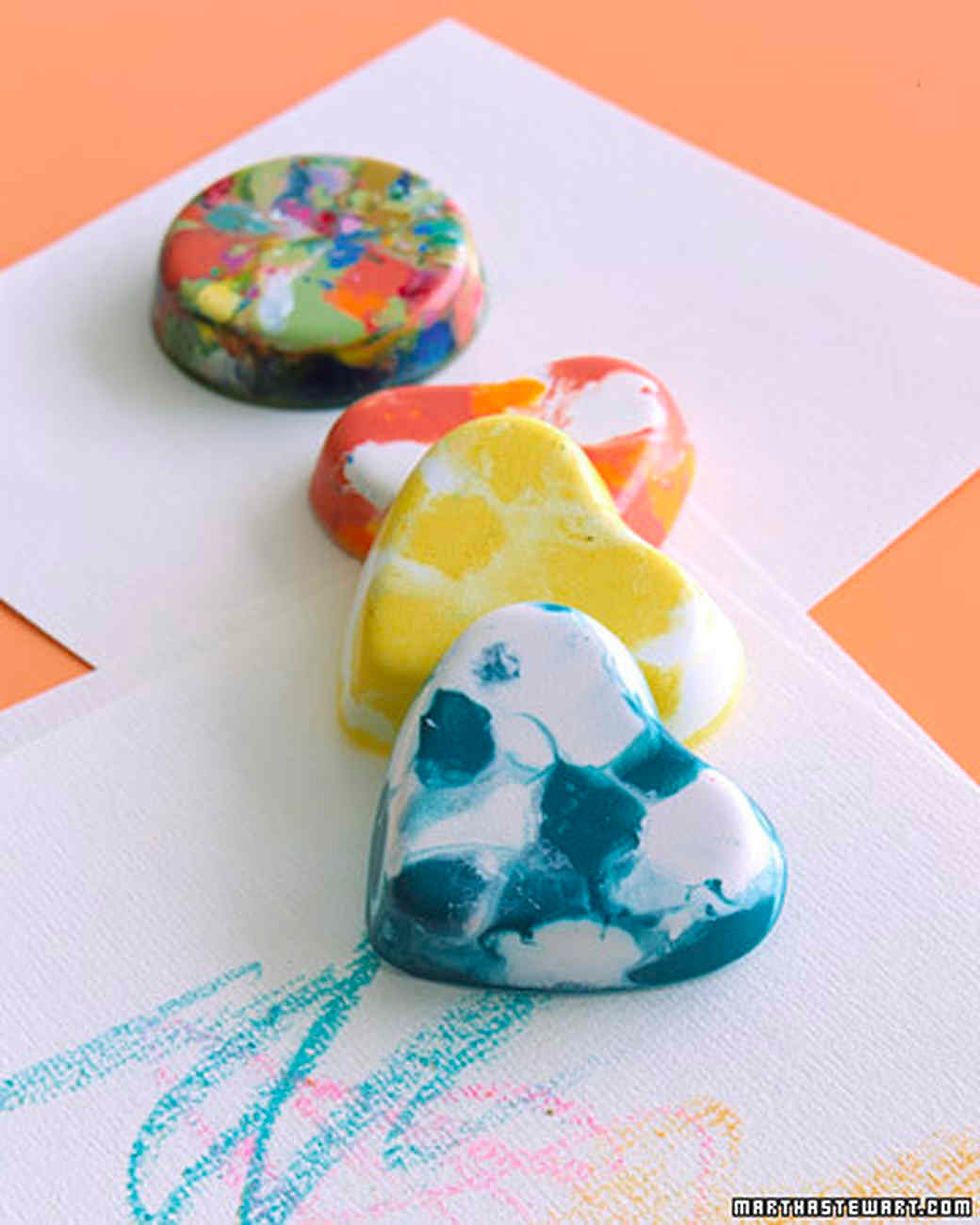
How to melt Crayons: https://littlebinsforlittlehands.com/melting-crayons/
Notes:
- I was unable to actually experiment with these for my blog, but I have attached a link for a video about melting crayons and a blog that lists some steps for making new crayons.
- I remember making new crayons in 4th grade, and it was very exciting to transform crayons into new shapes.
- Melting crayons can also give an artwork fascinating texture and transform 2-D into 3-D.
- However, these two techniques require heat, and it is crucial to make sure no one gets hurt or burned while engaging in these techniques.
Scraping Back / Scratchboard: Using Crayola

Notes:
- The jumbo black crayon made covering the whole paper so much easier because of its size and grip ease.
- I used Crayola because I learned from my testing they are excellent at evenly layering, unlike Cra-Z-Art.
- This technique was fascinating and could be used to explore the idea of layers and history.
Transfer: Using Crayola

Notes:
- You have to press it down very hard to transfer it entirely from page to page.
- I used a pen to get small details and crisp lines, but maybe I could use a crayon or blunter object to transfer large areas of space.
- This could be used to get patterns like the plaid I created at the top left or detailed gradient work.
Scratching First then Drawing / Hidden Lines: Using Crayola

Notes:
- This technique can be used to get thin white areas that won't be covered up by crayons.
-It was really helpful to have a paper on top that I could just trace because it helped me not get lost where I was making marks.
- You do have to press fairly hard to get a line, and while I used a pointy stick, I believe that using a sharpened pencil on a paper above the paper you are drawing on.
Crayon Resist Watercolor: Using Crayola

Notes:
-To do this technique, you need to draw with white on the paper and then put watercolor on afterward.
- It can be hard to keep track of where your white line is on white paper, so it can be helpful to have a light outline already in place or sine light on it to see the wax’s reflection.
- It was also hard to keep the white crayon consistently creating crisp lines, so I transitioned to entirely blocking out things such as the leaves.
- If used as an outline, you also have to be very careful of where the edge lies as not to overpaint it or under-paint it with watercolor.
- I know that this technique is very popular for creating snow falling from the sky.
Multicrayon lines: Using Cra-Z-Art

Notes:
- It was easier to control two crayons than four because with more crayons comes more room for one to slip out.
- This technique was fun to play around with but was harder to think of practically used for.
- This could be possibly used for creating a 3-D-like effect.
- This could also be used to explore typography.
Other Types of Crayons:
Twistables:
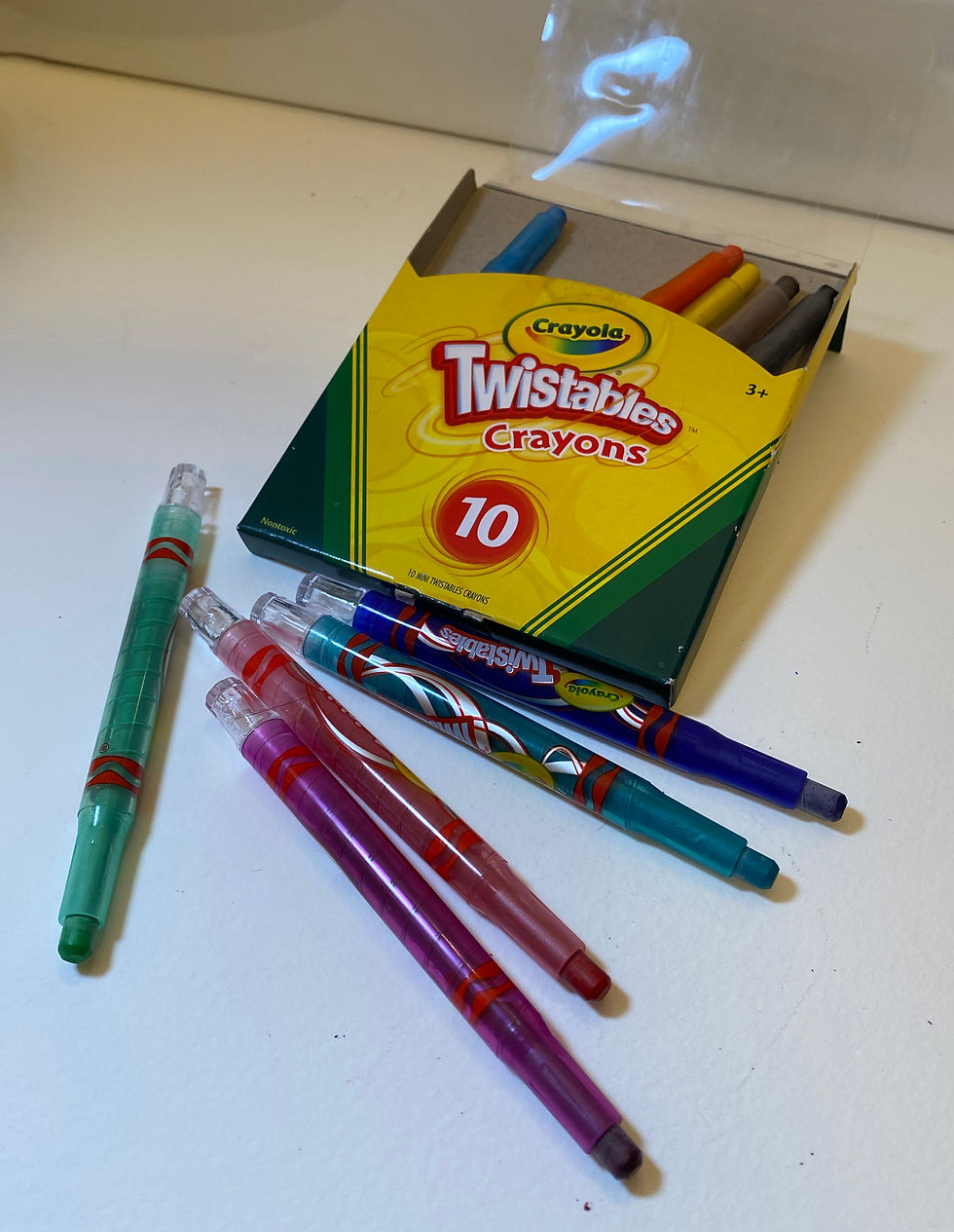
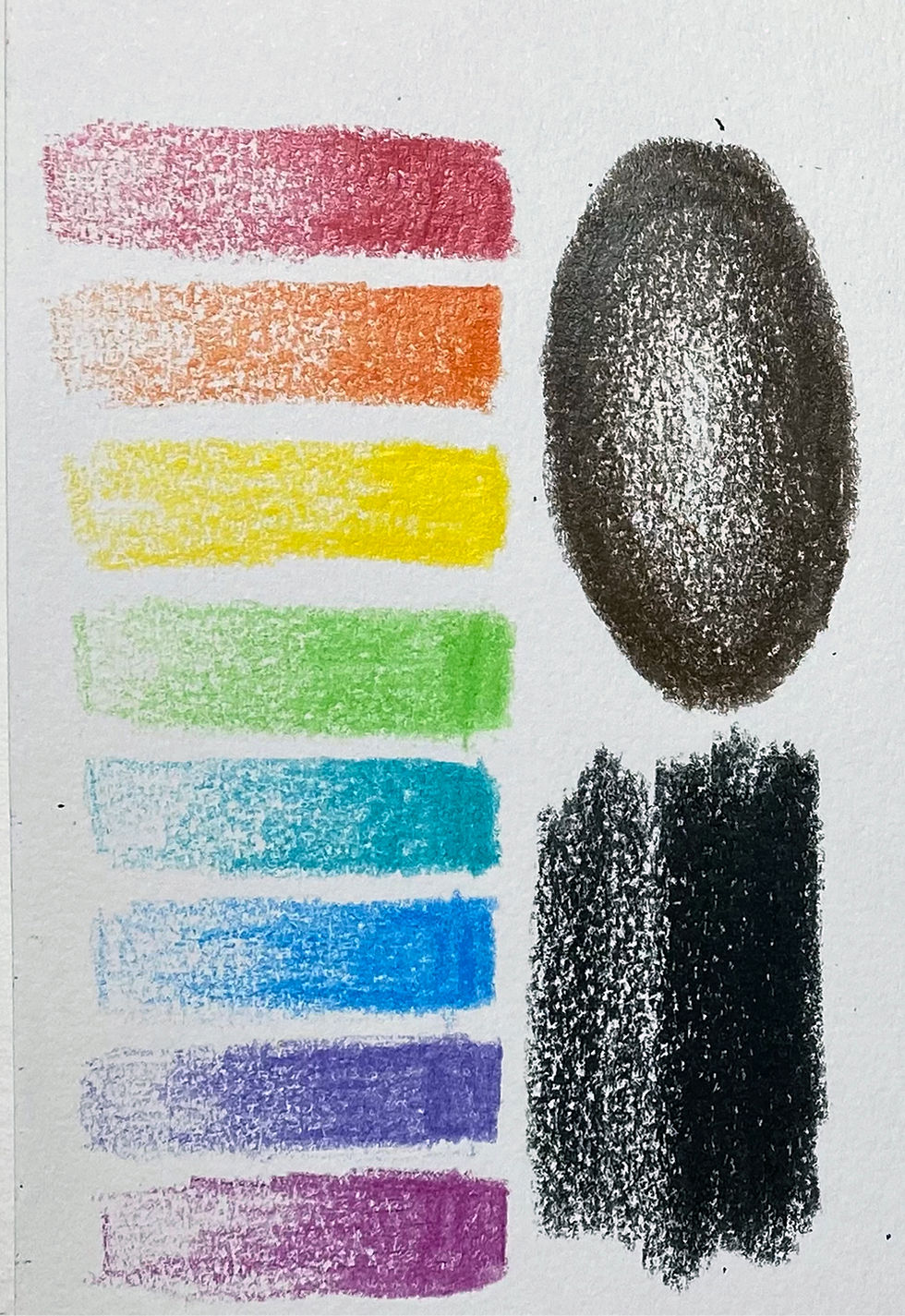
Notes:
- Colors work essentially the same as regular Crayola crayons, with no significant difference besides the inability to turn it sideways to create a rubbing effect.
- No sharpening is needed; just twist to make the crayon longer or shorter.
- Less mess when storing because crayons can’t rub together or in a container.
- Harder core (to keep it from breaking too easily); however, there are still prone to breaking off occasionally.
- A longer body that gives kids more room to grab on to.
- No paper on the crayon, which means no mess from paper being ripped off, but there is also no color names of the tool themselves (they are on the back of the box) which means you have to rely on the tube color, which can be misleading.
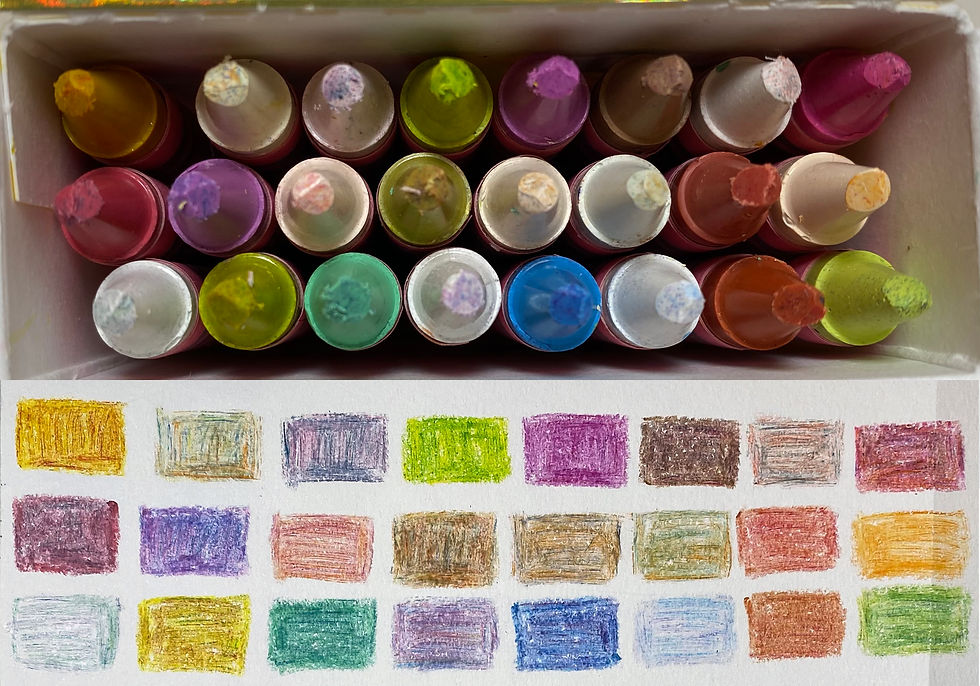
Confetti:

Metallic:

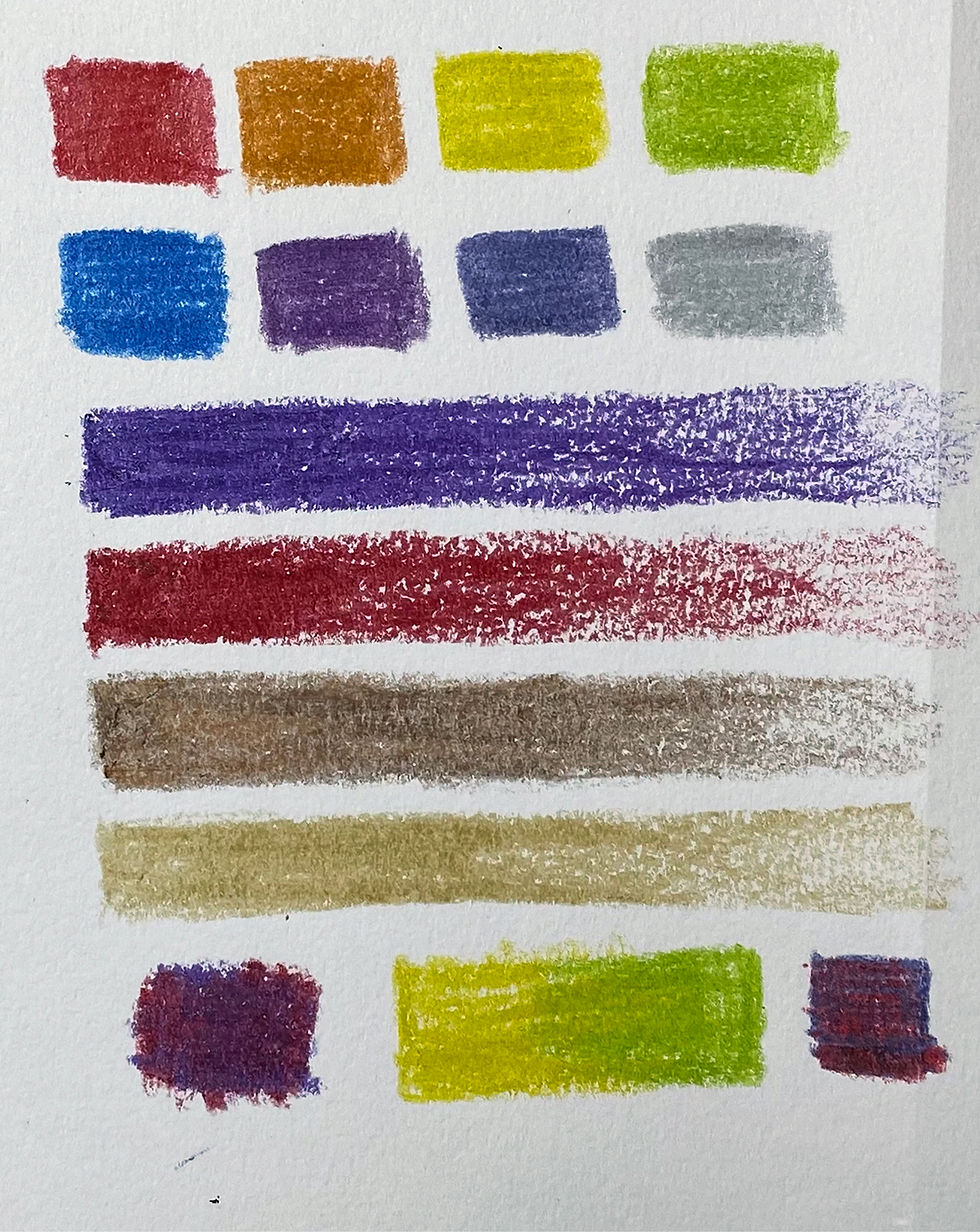
Notes for both Confetti and Metallic:
- Fun different colors of crayons outside the normal range.
- Confetti contains little broken specks of others colors in one colored crayon, and Metalic has glitter and shimmer in their color formula.
- Both of these crayons behave in ways similar to regular Crayola crayons with a decent range in value, blendable nature, excellent coverage, and even layering.
- The difference from regular crayons is that these add in a type of unpredictability (especially confetti) and have varying visual effects.
- Sets like these are an excellent addition to regular packs because of their added features.
Ultra-Clean Washable Large Crayons:


Notes:
- As its title suggests, this crayon is really good at lending itself to being cleaned up from various surfaces, such as a wall.
- This crayon feels moister than regular crayons and can go on the paper with less resistance.
- Like the other different Crayola types of crayons, this one behaves very similarly to how ordinary Crayola crayons behave.
- However, this crayon is much more prone to smudging than the standard type.
- This type of crayon seems best for very young kids, either at home or in a place where the teacher is worried about kids drawing on the table or wall.
Paperless Faber-Castell

Notes:
- These crayons felt very different and were harder than the other Faber Castel Crayons I was using because they were made with beeswax, while these were made with paraffin.
- These crayons were harder to transfer pigment.
- Paperless crayons save on paper waste and mess.
- The grips were helpful, but my hand was still sliding a little as I tried to color with it.
Safety measures while using Crayons:
While toxic crayons exist, using non-toxic crayons is always a better choice. Crayons are typically safe for young children and older. On my Crayola 48 pack, it says that it is AP approved. However, small crayons are dangerous for babies or young kids to use because they have a habit of putting everything in their mouths. If eaten, it can cause the child to choke or later get an upset stomach. Additionally, kids need to wash their hands after using crayons that smudge.
More info from The Children’s Hospital of Philadelphia about what to do in specific scenarios: https://www.chop.edu/centers-programs/poison-control-center/crayons#:~:text=Crayons%20are%20generally%20made%20from,fit%20into%20a%20child's%20mouth.
Possible Applications for Different Ages of Students:
Crayons are the most suitable for elementary students, especially in K-4. This is because of the material’s easy to use, mess-free, and child-safe nature. I would mostly look into getting Crayola large or triangular-shaped crayons for these students because of their easy-to-grip form and harder-to-break formula. For especially young children who I may not be able to watch over easily, Ultra-Clean Washable Large Crayons are a great option as a preventative measure against drawing on material not meant to be drawn on such as tables or walls. I would also recommend switching to smaller crayons as the child gets older because their fine motor skills will improve to allow them to use these crayons easier. They will also appreciate the smaller detailed work they can get with these crayons. Personally, I would not use crayons with middle school students because I think that they will be at an age where they will believe that crayons are only for younger children and would be much more interested in learning about other more advanced materials. The only exception is if crayons are used in relation to another media, such as watercolor, to create a resist. However, I think that reintroducing crayons to older high schoolers could be an exciting experiment in
challenging their view of how ‘good’ art should be made. I believe that asking them to explore this material in every way they can think of could help open their eyes to their own bias about materials and how every material can be used in many different ways to produce amazing work.
Comfort level going forward:
Having completed this study, I feel exponentially more confident in my skills and knowledge of this material. I can already see how some of the things I was studying could turn into lesson plans or projects. However, I can always use more practice, and I would definitely need to do more review work before creating anything. I feel comfortable navigating material and confident that this exploration has helped me better understand crayons’ strengths, limitations, and possibilities. The only thing I would like to do is continue testing out different types and shapes of crayons and explore melting/making your own crayon on my own when given the time and opportunity.


Comments