4-D Art
- Caroline Harding

- Apr 24, 2023
- 9 min read
Updated: Oct 30, 2024
Intro:
For our last assignment, we were tasked with jumping into the world of 4D art.
With the advent of technology, artists have been able to explore new dimensions of their art, both metaphorically and literally. 4D art is a relatively new concept that takes the traditional 3D art form to a new level by incorporating time as a crucial element. It is a form of art that adds movement and dynamic elements to 3D objects, creating an immersive experience for the viewer.
The term 4D art can be used to describe a wide range of art forms, including animations, projections, installations, and performances. It allows artists to play with the viewer's perception of time and space, creating a sense of depth and movement that was not possible with traditional 3D art. The addition of time as a dimension brings a new level of complexity and challenge to the artistic process, requiring artists to consider the temporal aspects of their work as well as the visual and spatial elements.
4D art has become increasingly popular in recent years, with advancements in technology making it more accessible and easier to create. It has found a home in a range of fields, from entertainment to advertising and even scientific visualization. It offers an exciting new avenue for artists to explore and a unique way for viewers to experience art. In my post, we are going to delve deeper into the world of 4D art through my own experimentations.
Prompt:
What issues/ideas/practices do you feel most strongly about your
culture? Why? And, what would be your message to others who may
be unaware of such issues/ideas/practices?
What type of visual cultural production work best to convey your
message (e.g., short film, music video, performance art documentation,
stop-motion animation, etc.)?
For this assignment, I decided to continue the tread that I have been exploring this semester with my Danish identity for this last project.

As someone who is both American and Danish, I have a unique perspective on the world, but I also experience tension between these identities. While I grew up in America and knew the culture here very well, my experience with Danish culture is limited to the yearly trip to Denmark that has never been longer than three months stay, and I do not speak the language. This can sometimes lead to a feeling of disconnect as if I am neither fully American nor fully Danish. However, I still feel a strong connection to my Danish roots and am constantly striving to learn more about the culture and language. Being both American and Danish has allowed me to appreciate and understand the nuances of different cultures, but it also requires a delicate balance between the two identities. This tension is what I wanted to address for this assignment. I had a series of videos that I took from the last time I was in Denmark, the summer of 2021 when I stayed for three months to secure my citizenship. I wanted to interslice those videos with videos I took of myself here in America to create a video montage that capture the tension that exists between these two identities.
Materials/Process:

For this assignment, I needed both a recording device, which was my iPhone, and video editing software to compile all the footage together. I start off using OpenShot, a free video editing program I am familiar with. However, I ended up switching to Final cut pro after something went wrong during the installation process with OpenShot. Final Cut Pro is a professional video editing software designed for Mac operating systems. It was developed by Apple Inc. and has become a go-to tool for many video editors in the film, TV, and advertising industries. Final Cut Pro offers a wide range of features, including non-destructive video and audio editing, color correction, visual effects, and motion graphics. The software’s user-friendly interface allows editors to easily navigate through the different tools and features, making it accessible for beginners as well as professionals. However, this software isn’t free like OpenShot, but I was able to get a 90-day free trial to complete this project while I figured out why OpenShot wasn’t working for me.

To start this project, I compiled all the videos I had taken in Denmark and put them into my library in Final Cut Pro. Then I went around taking videos of me interacting with and existing in the environment here in Northern Virginia. The video I took included me walking around, tapping my foot, looking into the camera, driving, sitting outside, or looking at sweaters. I thought it would be interesting to include myself in all the videos I took because when looking at the whole project, I will only exist physically in the NOVA videos and not in the Danish ones, which ties back to my struggle with identity.

When editing the videos, I utilized the trim option frequently to slice all the different videos together. I wanted to try to create this in-between space between these two different cultures by having them shift or overlap between these two dualities throughout the whole length of the video.

I also worked to create this in-between effect by utilizing the layering aspects of this software and different opacity and blend modes to create my desired effect. It was very fun playing with these settings to see what effect I could create. One of my favorites is the overlay of the water on top of the buildings that I walked past in the middle of the video.

Another technique I played around with was the speed and direction of the video that was playing. There were a couple of videos that I sped up a little bit to play with the perception of time, including one section on driving by water. Then, there was the driving in a car video that I reversed for all but one clip. I wanted to further exacerbate the differences between these two places by making it feel like the rules of reality worked differently here.

Lastly, one other technique that I played with was the sound setting. I was able to detach audios from the clips to change where they were placed, how loud they were, and how frequently they showed up. I tried to place sounds that sometimes didn’t match what was happening on screen, creating a feeling of things not aligning or making sense.
Throughout the video, I mainly focused on one video I took of a bunch of seagulls flying around a little sand island. I took this video in Denmark when my brother, grandfather, family friend, and I all went out on a boat to pull up some crab nets. When we got close to this island, a bunch of seagulls suddenly took flight and started crying out. They seemed to be saying, “you’re not a seagull, we don’t know you, go away!” over and over again. I felt like this sound perfectly captured my feelings about being Danish which is why it is heavily featured in the video. Additionally, one other aspect of the video that I included was a conversation my mom and I had where I asked her to say Danish works for me to try to repeat. This sound is constantly in the background for this whole video as I struggle to match my mom’s perfect pronunciation.
Artists:

"Pulse Topology" by Rafael Lozano-Hemmer. Covers any area between 1,000 and 5,000 sq ft. 3,000 LED light bulbs arrayed in a fermat spiral, contactless heartbeat sensors, audio playback (installation). 2021.
Rafael Lozano-Hemmer is a Mexican-Canadian artist who works with interactive installations, creating immersive experiences that engage with the audience in innovative ways. His art blurs the boundaries between art, technology, and science, often exploring themes of identity, memory, and social interaction. Lozano-Hemmer's work is considered 4D art because it incorporates time as an integral component, with interactive elements that respond to the viewer's presence and create an ever-changing experience in real-time. His installation,"Pulse Topology" is an example of 4D art as it uses the viewer's heartbeat to create a constantly evolving light display, engaging with the fourth dimension of time.
Website: https://www.lozano-hemmer.com
"Muto" by Blu. 8 mins. Animation and spray paint. 2008.
Blu is an Italian street artist known for his large-scale murals that often incorporate socio-political commentary and surreal imagery. He first gained recognition for his stop-motion animations and has since become known for his public art, which can be found on walls and buildings around the world. Blu's work is considered 4D art because it often incorporates the fourth dimension of time, with murals that change depending on the viewer's perspective and the changing environment, as well as stop-motion animations that create an illusion of movement and progression over time.
Website: https://blublu.org/b/
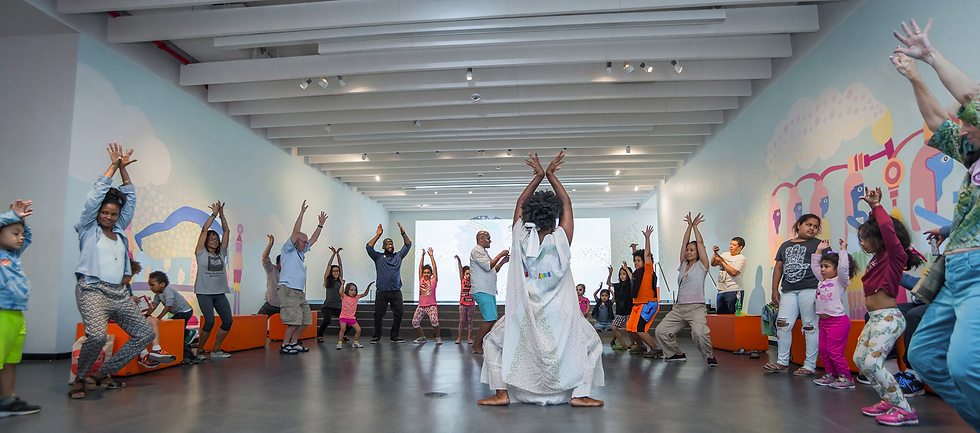
"The Pollen Catchers’ Color Mixing Machine" by Saya Woolfalk. Interactive installation. 2015.
Saya Woolfalk is a Japanese-American artist whose interdisciplinary practice encompasses installation, performance, and video. Her work explores hybrid identities and speculative futures, often drawing inspiration from science fiction, anthropology, and mythology. Woolfalk's art is considered 4D because it frequently incorporates time and movement as integral elements, such as in her ongoing project "The Empathics," where she creates immersive installations that invite viewers to participate in a fictional culture's rituals and traditions through interactive technology and performance.
Website: http://www.sayawoolfalk.com

"We Already Have What We Need" by Cauleen Smith. Variable dimensions (five screens: 22.5 x 12 feet each). Multi-channel video installation with projectors and other objects. 2019.
Cauleen Smith is an American interdisciplinary artist whose work spans film, video, sculpture, installation, and performance. She explores themes of history, identity, and spirituality, drawing inspiration from Black feminist theory and science fiction. Smith's art is considered 4D because it often incorporates time and space as key elements, creating immersive installations that engage with the viewer's physical presence and perception, such as in her piece "We Already Have What We Need," which features multiple videos to create a multi-sensory experience that evolves over time.
Lesson Ideas:

Karin Lehmann's "Sediment Sampling" (2014), an installation composed of 200 unfired pots filled with water.
The art lesson focuses on creating an unfired ceramic project that is left to be affected by time, specifically by natural elements such as wind, rain, and sunlight. The lesson emphasizes the idea of 4D art, as the project will change over time, adding a temporal dimension to the artwork. The project allows for students to experiment with the concepts of ephemerality and change in their art, as the final result will be unpredictable and unique. The lesson emphasizes the importance of considering time as a key element in art and encourages students to think about how time affects their artwork in ways that they cannot control. Overall, this lesson promotes the idea of art as a dynamic and evolving process, and encourages students to consider the fourth dimension in their creative process.

Light painting created by Darren Pearson
This art lesson introduces students to light painting, a photography technique that captures long-exposure images of moving lights in a dark environment. Students will learn about the principles of light painting and how it can create a dimensional visual effect that gives a sense of motion and depth to a static image. They will experiment with different light sources and materials and learn how to manipulate light to create dynamic and engaging images. Through this lesson, students will develop critical thinking and problem-solving skills by reflecting on the impact of light on their images and how they can use light painting to communicate a message or tell a story. The lesson requires a camera with manual settings and tripod, various light sources such as flashlights and LED lights, and a dark room or environment for light painting. This project relates to many aspects of 4D art because of the time base component that is play during this process.
General Reflection:
Overall, I found the 4D art from to be a unique method of making that allows for the creation of dynamic and interactive objects that change over time. I did find it challenging to film videos of myself without help from another person, which makes me think that this project might function very nicely in a collaborative setting. In terms of teaching applications, this type of project could be a great way to engage students of all ages in exploring their own cultural identities through art.
For younger students, 4D art projects could look like using paper, clay, or mixed media to explore simple animation techniques like stop-motion. For secondary-school-aged students, 4D art projects can be more complex and involve more sophisticated materials and techniques. Projects that use projection mapping, or interactive installations can be appropriate for this age group, as they can provide more opportunities for exploration and experimentation. Projects that explore social and cultural issues, or themes such as environmental sustainability, can also be beneficial for this age group, as they can help students develop critical thinking skills and engage with broader societal issues. Projects that involve collaboration with other students or community members can also be appropriate for all age groups, as they can help develop teamwork and communication skills. Overall, there is a lot of potential within 4D art as a teaching tool for exploring different ideas and encourages students to think creatively and experiment with new forms of artistic expression.


Comments